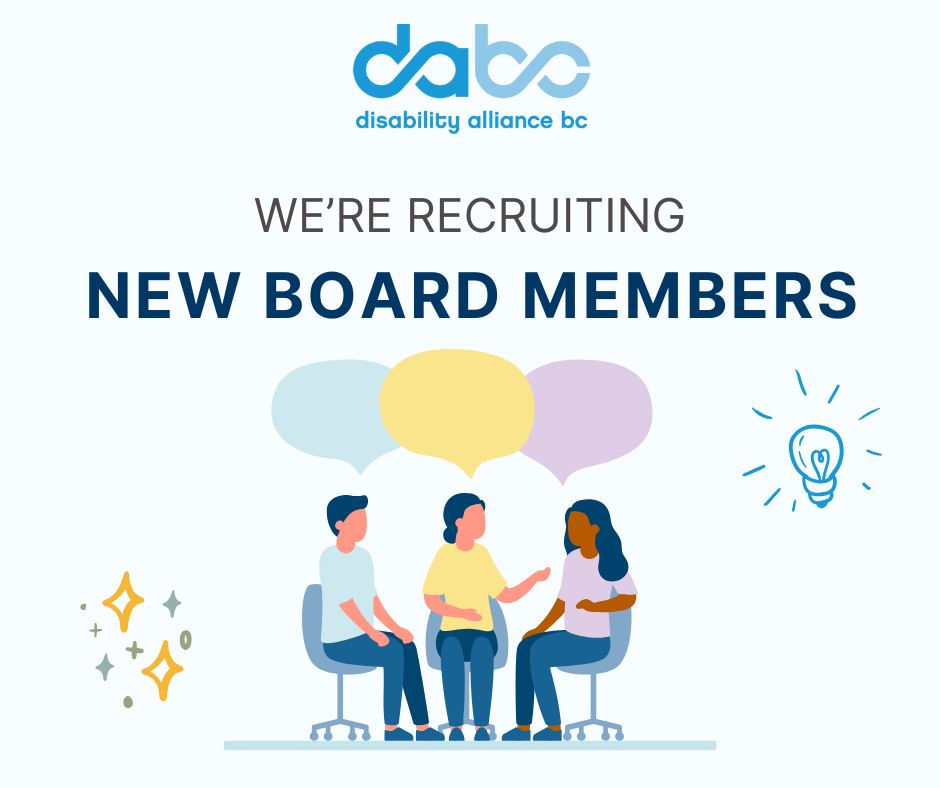
Join the Disability Alliance BC Board: Make a Difference! Are you passionate about disability advocacy? Do you want to use your lived experiences to drive positive change? Disability Alliance BC (DABC) is looking for three (3) individuals to join our Board of Directors in 2025!
Who We’re Looking For:
Dedicated Advocates: If you have a passion for disability rights and advocacy, we want you!
Diverse Voices: We welcome candidates from all over BC, especially those from Northern, Interior, and rural regions. We strongly encourage applications from BIPOC and 2SLGBTQIA+ communities. We value lived experiences that reflect the diversity of our province.
Experienced Leaders: Prior experience on non-profit or community boards is a plus, but not required.
Specific experience being sought: While we will happily accept applications for candidates with any professional background, our Board would particularly welcome applications from:
Lawyers/legal professionals
Public sector (government) employees
Corporate/for-profit sector workers
Why Join Us?
Since 1977, DABC has been a powerful voice for people with disabilities in British Columbia. We are a provincial non-profit and registered charity dedicated to supporting people with all disabilities to live with dignity, independence, and as equal participants in the community. We promote disability issues through direct services, community partnerships, advocacy, research, and publications.
What You’ll Do:
As a Board Member, you will:
Provide leadership and oversight to our Executive Director.
Ensure legal, financial, and ethical accountability.
Help guide the implementation of our strategic plan.
Use your experiences to inform our systemic advocacy and policy work.
Represent DABC’s mission in your community and networks.
Commitment:
Our Board meets virtually, six times per year, with additional opportunities to contribute through committees or special initiatives. We strive to keep the time commitment manageable and accessible for all.
Eligibility: To join, you must be:
A person with a disability.
A member in good standing with DABC (membership fee: $15).
How to Apply:
Ready to make an impact? Email our Board & Communications Coordinator, Chloe Krause, at chloe@dabc.ca for a nomination package. This will include:
A nomination form (completed by a nominator).
A form detailing your reasons for seeking nomination.
A list of Board duties and responsibilities.
DABC’s Annual Report.
Deadline: Applications are open on a rolling basis and will be considered until Saturday August 10th. We look forward to hearing from you!
Download a copy of this Call for Nominations here.
DABC recently submitted our recommendations for Budget 2026 to the Select Standing Committee on Finance and Government Services. Our submission is below.
Please note that we were only able to submit a maximum of three recommendations. We made additional recommendations in our election priorities document, which was sent to each political party in September 2024. You can see our post about this here and download the document here.
Disability Alliance BC (DABC) is a provincial cross-disability non profit organization and registered charity, advocating for the rights of people with disabilities. The focus of our submission will be on ensuring that the BC Government invest in programs which will improve the financial security of low-income people with disabilities across our province, particularly focused on Disability Assistance, Public Transportation, and Affordable, Accessible Housing.
Recommendation 1 (300 characters): Indexing Disability Assistance rates to inflation, and removing clawbacks from employment insurance income and spousal income for people on Disability Assistance.
Explanation (2000 characters):
DABC calls upon the BC government to make good on their commitments to poverty reduction as listed on page 34 of the 2024 Poverty Reduction Strategy, specifically: “considering the case for indexing rates to inflation”, and “Considering income exemptions that could stack benefits and help people retain more income – Examples could include changing the rules around spousal income or exempting federal benefits like Employment Insurance from income.”
People on PWD deserve to feel financially secure; they should have reassurance that their PWD income will increase if inflation increases; and they should feel secure in knowing they can access their federal right to Employment Insurance (EI) without having their PWD income clawed back.
EI should be treated as a form of earned income, not unearned income, because workers contribute their employment earnings to EI through a deduction in their pay cheque. Everyone who pays EI premiums can rely on EI benefits being there when they need them, including PWD clients, however the difference is that PWD clients “are required to pursue and accept the other income or means of support,” meaning that they must accept EI if they are eligible, but have no recourse to stop their PWD income from being clawed back. We believe this clawback of EI benefits discriminates against PWD clients, which hinders them from escaping the cycle of poverty.
Lastly, people with disabilities who need to access Disability Assistance should feel financially secure without relying on income from their spouse or partner. Relying on spousal income expects that the non-disabled partner is responsible for the disabled partner’s livelihood and well-being. The current PWD system is actively encouraging people on PWD to remain single or make it very difficult to obtain and sustain a relationship. The spousal cap is in direct opposition with a person’s right to independence and equal opportunity, and therefore discriminates against people with disabilities.
Recommendation 2: Streamlining the provincial bus pass program for people with disabilities to include HandyDART rides.
Explanation:
DABC calls upon the provincial government to make good on a campaign promise within the BC NDP’s action plan that was launched ahead of last year’s election, namely “Improve transit for people with disabilities by bringing BC’s HandyDART service into government, instead of sub contracting the service to a private company.” DABC wishes to see HandyDART brought within government control not only because it will guarantee greater accountability to the public and the disability community on the state of its operations, but will also pave the way for HandyDART to more easily become integrated into the BC bus pass program, which is available to seniors and people on Disability Assistance.
Transport 2050 states that its goal is “a “fairer and more just and inclusive transportation system that truly delivers on the promise of Access for Everyone.” A more inclusive public transportation system would involve bringing HandyDART into the BC bus pass program so that low income people with disabilities who are unable to navigate conventional public transit would be able to access this much-needed service. Currently, people on Disability Assistance have to pay out of pocket for HandyDART, which we believe is a form of financial exclusion.
Recommendation 3: Build more affordable, accessible housing that includes two, three, and four-bedroom units.
Explanation:
While DABC is heartened to hear of the BC Government’s investments being made to combat the housing crisis in our province, people with disabilities in need of accessible, affordable housing are falling through the cracks.
DABC’s Right Fit program is the only program of its kind in Canada that matches wheelchair users to accessible housing. In our experience detailing the inventory of accessible housing in Metro Vancouver, we have observed a strikingly critical gap of multi-bedroom accessible housing. The vast majority of accessible units that have been built over the past few decades are one-bedroom or studio units. This neglect for multi-bedroom accessible units actively excludes families, particularly newcomer families, in need of accessible housing. There are over 70 families on our waitlist that have waited years for a multi-bedroom accessible unit to become available. Instead, they have no choice but to live in in-accessible housing, which by the Canadian definition, are considered homeless; they are the unseen and unserved component of the homeless population.
DABC calls upon the provincial government to make dedicated commitments to building multi-bedroom accessible units, as well as providing targeted financial support through rental subsidies for low income people with disabilities who have been priced out of the rental housing market. Rental subsidies are crucial to reducing the effect of poverty on people with disabilities who depend upon a scarce supply of accessible, affordable housing.
LETS is collaborating with Women Transforming Cities to co-create a workshop on participating in local government with a disability justice lens.
If you are a person living with a disability (or disabilities), LETS invites you to participate in this survey which will help them understand some of the barriers you face and personal experiences around civic participation. The survey deadline is July 2.