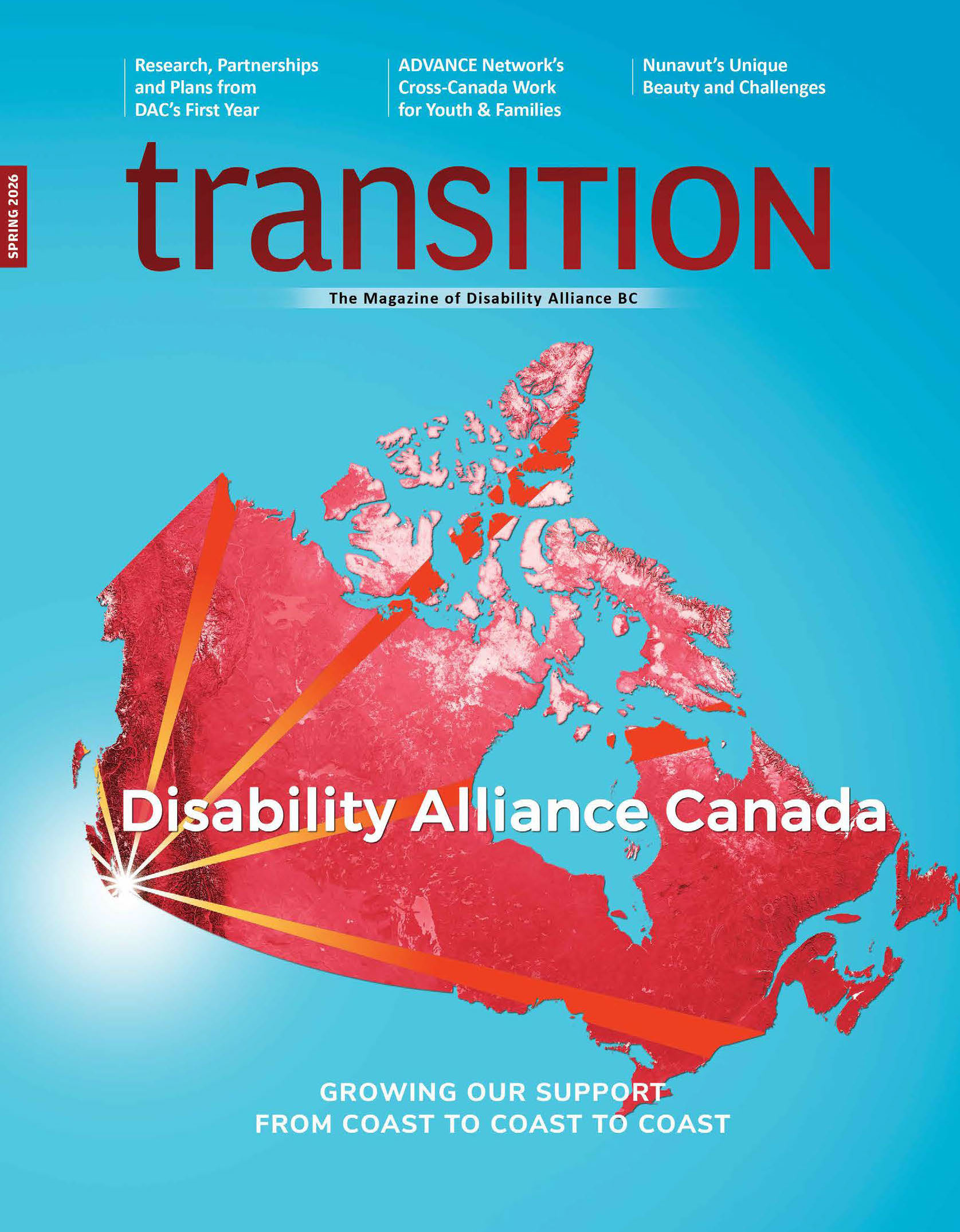
The theme of the Spring 2026 edition of Transition magazine is Disability Alliance Canada: Growing Our Support from Coast to Coast. As we reflect on Disability Alliance Canada’s (DAC) first year, we hear from organizations doing great work across the country and share what we’ve learned about unmet needs that will shape DAC’s systemic advocacy.
We’re always happy to consider articles or creative work from our community partners and from people living with a disability. If you’d like to send along your ideas or feedback, email: transition@dabc.ca.
This article was written by Robin Loxton, and originally appeared in the edition of DABC’s Transition magazine, Following Their Path: How disability trailblazers are guiding today’s advocacy (Fall/Winter 2025).
Read the full edition in PDF format here and in text-only format here.
If you’re interested in contributing to Transition as an individual or an organization, please email transition@dabc.ca.
This edition of Transition Magazine is dedicated to the late Pamela Horton. Pam served on DABC’s board of directors for close to thirty years. If you’d like to support Transition, we have set up a fund in Pam’s name. We so appreciate any contributions.
The Advocacy Access program of Disability Alliance BC (DABC) officially opened in 1989, at then-BC Coalition of the Disabled. I was one of the first two advocates to be hired and I continued to work with the program until 2016.
Over those 27 years, there were many victories, setbacks, happy moments and frustrations. I don’t feel comfortable calling myself a “trailblazer,” but here are some reflections on our advocacy work back then and what I think is still important today.
My reasons for becoming a disability advocate had a lot to do with understanding that the onset of disability is most often life-changing. We face loss of income, the need to repeatedly “prove” we have a disability to qualify for benefits, and a confusing muddle of information about programs that may or may not help us. All this, on top of living with a disability, can become overwhelming.
Today, technology has opened doors for many of us in the disability community. With a smartphone or laptop, some of us can get the information we need in minutes. But with the good news there are a number of concerns. Navigating the internet can be a headache, especially if we are not familiar with computers. Misinformation can send us in the wrong direction because we cannot tell the difference between the real and the fake. And we still don’t know whether Artificial Intelligence will save or doom the world in years to come.
Back when I first started with Advocacy Access, there was no internet, if you can imagine. Personal computers were expensive and not widely used. We recognized the importance of accessible, community-based information on benefits programs, so we created help sheets on key programs. The help sheets are still being updated and expanded by the program, and can be downloaded free from the DABC website.
Our program was concerned when more applications went online. We began to hear about access issues from people with disabilities, including applications for disability benefits. For many people, these forms were not any easier to fill out or send in. Too often, I heard reports of people believing they had submitted an online application only to find out it was never received. And, yes, I agree with those who would rather talk to a person than a computer when you’re looking for help.
One thing that has become much worse since I was with DABC is the availability of family doctors. There is a shocking number of us who don’t have a doctor at all or don’t have one who knows us. Maybe you’re one of them.
This is not only a a huge problem because our health needs are not being met, but it also means we have no one to fill out the forms to get health-related benefits and services. Accessing telehealth is better than nothing, but this is not the same as having a doctor who knows you and your history. For those of us who have a family doctor, one of the last things a doctor wants to do is spend time filling out lengthy forms. Government needs to do a better job of streamlining application processes and information requests.
My greatest concern as a disability advocate is the threat of poverty that continues to face our community. Over the years, we advocated more or less constantly for the government to increase the disability benefit rates.
Yes, there has been some progress. There are higher earnings and asset exemptions, and we have the new federal Canada Disability Benefit, the Registered Disability Savings Plan and sporadic increases in provincial disability benefits. But the reality is, for many of us, our incomes do not come close to keeping up with the rising costs of living and living with a disability.
The gap between income and daily living costs becomes more obvious each year because of the high cost of housing in British Columbia. The maximum shelter allowance for a single person on disability assistance is $500 per month. The average rent in September 2025 for a studio apartment in BC is $1,784.
No wonder so many of us are fearful of homelessness.
Now more than ever we need organizations like DABC to follow the path the community has been building over the last few decades. We also need DABC as a provincial cross-disability voice at the provincial level. Individuals continue to need information, advice and help around disability programs. And organizations and individuals are forging paths to expand disability advocacy into social justice arenas and intersectional work.
The job of an advocate is never done.
After leaving DABC in 2016, Robin moved to the Cowichan Valley on Vancouver Island. Living in a small town, after many years of city life, has been an adjustment. But I have come to love the vitality of this community, and appreciate and support the many people who advocate for social justice.
DABC is hiring for two positions within our Access DTC Program. Find out more below and see the full job postings on our Careers page.
We are committed to fostering a respectful, inclusive and equitable workplace which is representative of the community we serve. We welcome those who have demonstrated a commitment to upholding the values of inclusion, anti-ableism, anti-racism and reconciliation. Applications are encouraged from members of groups that are historically disadvantaged and underrepresented, including Indigenous persons, and people of all sexual orientations, gender expressions and identities. People with disabilities are especially encouraged to apply. Accommodations are available during the hiring process, upon request.
DTC Community Advocate
Open: August 1, 2025 Closes: August 22, 2025 Location: Vancouver, BC Category: Community and Social Services Job Type: Full-time, One-year fixed term Salary: $54,000
The Access DTC program provides direct support through the Disability Tax Credit (DTC) and related benefits including the Child Disability Benefit, Canada Disability Benefit and Registered Disability Savings Plan to promote financial literacy and financial security for people with disabilities in British Columbia. Access to the DTC and related benefits has become more relevant, as many people with disabilities will need the DTC to apply for the Canada Disability Benefit. We are seeking advocates passionate about social justice issues to join our dynamic team and help grow our impact in BC and beyond.
Job Description – Community Advocate
You will join a team of advocates, working one-on-one with people with disabilities to provide in-depth support through the DTC and associated benefits, and helping people claim the DTC by filing their income taxes. You will help raise awareness about DTC through the development of strategic partnerships and community outreach. You are also an active team member, able to contribute to the additional administrative responsibilities associated with the day-to-day operation of the program.
Vancouver Island Community Advocate | Access DTC Program
Post Open: August 1, 2025 Post Closes: August 22, 2025, 4:30pm Location: Vancouver Island, BC Category: Community and Social Services Job Type: Contractor (3 days/week) Term: Until March 31, 2026, with possibility of extension Salary: $34/hour Report to: Vancouver Island Community Engagement Specialist, Director-Access DTC Program, Disability Alliance BC
Project Background
Through a new RDSP initiative, the Access DTC program works to reduce poverty and barriers to long-term financial stability for people with disabilities living on Vancouver Island. The RDSP is a long-term savings plan designed to help people with disabilities access significant financial savings for their future. The successful candidate will help to increase access to the DTC, RDSP, and other related benefits by raising awareness about the program and supporting people across Vancouver Island communities to navigate through the application process.
Duties & Responsibilities
Under the supervision of DABC’s Access DTC Program Director and Vancouver Island Community Engagement Specialist, the Community Advocate will:
Provide one-on-one support (remote and in person) for people with disabilities to apply for the DTC and related benefits. Direct services will include facilitating mobile clinics across Vancouver Island and will require access to a motor vehicle to travel across Vancouver Island
Reach out to the community using a variety of means including developing educational materials, delivering of virtual and in-person workshops, establishing new community partnerships to improve DTC/RDSP uptake for people with disabilities on Vancouver Island
Create and deliver training modules to community service providers as well as health, educational, and financial professionals on the DTC/RDSP/related benefits to build capacity for sustained support within local communities
Work closely with Access DTC program partners, the Island Health Authority (IHA), and community partners by attending regular internal team meetings and meetings with partners.
A key part of the Resilient Futures Network convening was a discussion with representatives from Canada Revenue Agency on automatic tax filing. Participants explored both