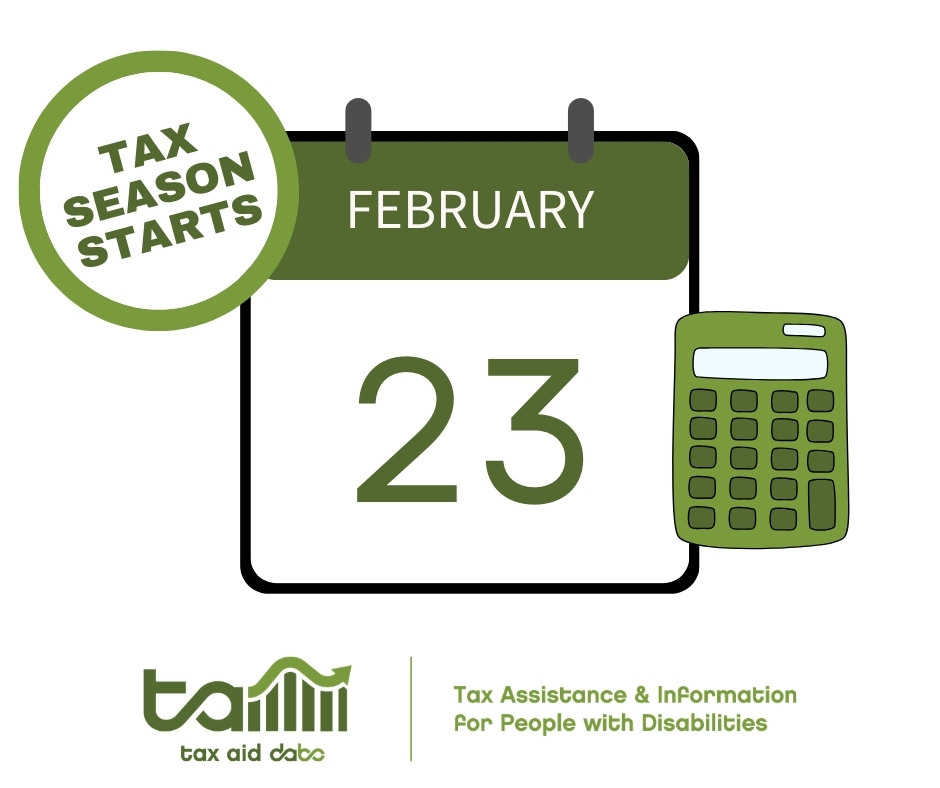
Tax Season is almost here! The CRA will re-open online filing on February 23rd, 2026.
Need help filing your taxes for the 2025 tax year (or previous years)?
Tax AID DABC offers one-on-one tax filing assistance in person, by phone, and by video conference. If you are a person with a disability living in BC on a low income, we can help with filings for current and previous years. We can also help you gather the documents necessary to file your taxes.
To access our online booking service or for contact info, please visit our website: Book your tax appointment.
On February 10th, the Province of BC announced the phasing in of a new B.C. Children and Youth Disability Benefit program and B.C. Children and Youth Disability Supplement, replacing the current autism funding program. With these changes, which were developed in consultation with families, service providers and experts, the Province aims to reach thousands more children and youth with a range of disabilities.
Over the course of 2026 and 2027, the new B.C. Children and Youth Disability Benefit will launch to provide families of children with significant disabilities with $6,500 or $17,000 per year based on their individual needs.
Starting July 2027, a new income-tested B.C. Children and Youth Disability Supplement will also become available to families with any child under age 18 who is eligible for the federal Disability Tax Credit. The supplement will provide up to $6,000 per year (based on the level of family net income), which families can use to pay for therapies, supports and services they believe are most helpful. The new supplement is designed to support families with middle and low incomes.
DABC is very heartened by the opportunity for a wider diversity of children with disabilities and their families to receive key supports, and applaud the Province for taking these steps toward equitable access to financial support.
We also recognize that some families receiving current autism supports may feel uneasy about these changes. We hope that these families will continue to receive the supports they need.
This article was written by Robin Loxton, and originally appeared in the edition of DABC’s Transition magazine, Following Their Path: How disability trailblazers are guiding today’s advocacy (Fall/Winter 2025).
Read the full edition in PDF format here and in text-only format here.
If you’re interested in contributing to Transition as an individual or an organization, please email transition@dabc.ca.
This edition of Transition Magazine is dedicated to the late Pamela Horton. Pam served on DABC’s board of directors for close to thirty years. If you’d like to support Transition, we have set up a fund in Pam’s name. We so appreciate any contributions.
The Advocacy Access program of Disability Alliance BC (DABC) officially opened in 1989, at then-BC Coalition of the Disabled. I was one of the first two advocates to be hired and I continued to work with the program until 2016.
Over those 27 years, there were many victories, setbacks, happy moments and frustrations. I don’t feel comfortable calling myself a “trailblazer,” but here are some reflections on our advocacy work back then and what I think is still important today.
My reasons for becoming a disability advocate had a lot to do with understanding that the onset of disability is most often life-changing. We face loss of income, the need to repeatedly “prove” we have a disability to qualify for benefits, and a confusing muddle of information about programs that may or may not help us. All this, on top of living with a disability, can become overwhelming.
Today, technology has opened doors for many of us in the disability community. With a smartphone or laptop, some of us can get the information we need in minutes. But with the good news there are a number of concerns. Navigating the internet can be a headache, especially if we are not familiar with computers. Misinformation can send us in the wrong direction because we cannot tell the difference between the real and the fake. And we still don’t know whether Artificial Intelligence will save or doom the world in years to come.
Back when I first started with Advocacy Access, there was no internet, if you can imagine. Personal computers were expensive and not widely used. We recognized the importance of accessible, community-based information on benefits programs, so we created help sheets on key programs. The help sheets are still being updated and expanded by the program, and can be downloaded free from the DABC website.
Our program was concerned when more applications went online. We began to hear about access issues from people with disabilities, including applications for disability benefits. For many people, these forms were not any easier to fill out or send in. Too often, I heard reports of people believing they had submitted an online application only to find out it was never received. And, yes, I agree with those who would rather talk to a person than a computer when you’re looking for help.
One thing that has become much worse since I was with DABC is the availability of family doctors. There is a shocking number of us who don’t have a doctor at all or don’t have one who knows us. Maybe you’re one of them.
This is not only a a huge problem because our health needs are not being met, but it also means we have no one to fill out the forms to get health-related benefits and services. Accessing telehealth is better than nothing, but this is not the same as having a doctor who knows you and your history. For those of us who have a family doctor, one of the last things a doctor wants to do is spend time filling out lengthy forms. Government needs to do a better job of streamlining application processes and information requests.
My greatest concern as a disability advocate is the threat of poverty that continues to face our community. Over the years, we advocated more or less constantly for the government to increase the disability benefit rates.
Yes, there has been some progress. There are higher earnings and asset exemptions, and we have the new federal Canada Disability Benefit, the Registered Disability Savings Plan and sporadic increases in provincial disability benefits. But the reality is, for many of us, our incomes do not come close to keeping up with the rising costs of living and living with a disability.
The gap between income and daily living costs becomes more obvious each year because of the high cost of housing in British Columbia. The maximum shelter allowance for a single person on disability assistance is $500 per month. The average rent in September 2025 for a studio apartment in BC is $1,784.
No wonder so many of us are fearful of homelessness.
Now more than ever we need organizations like DABC to follow the path the community has been building over the last few decades. We also need DABC as a provincial cross-disability voice at the provincial level. Individuals continue to need information, advice and help around disability programs. And organizations and individuals are forging paths to expand disability advocacy into social justice arenas and intersectional work.
The job of an advocate is never done.
After leaving DABC in 2016, Robin moved to the Cowichan Valley on Vancouver Island. Living in a small town, after many years of city life, has been an adjustment. But I have come to love the vitality of this community, and appreciate and support the many people who advocate for social justice.