DABC Job Opportunity: Articling Student, Disability Law Clinic

Open: February 3, 2026
Closes: February 27, 2026
Location: Vancouver
Category: Non-Profit Legal Job
Type: Full-time
Salary: $65,000

Who We Are

Since 1977, Disability Alliance BC (DABC) has been a provincial, cross-disability voice in British Columbia. We are a non-profit, charitable organization that champion issues impacting the lives of people with disabilities. Our mission is to promote a more inclusive and equitable society for people with all disabilities through direct services, community partnerships, systemic advocacy, research, and publications. through our direct services, community partnerships, advocacy, research and publications.

Program Description

The Disability Law Clinic (DLC) provides free, confidential legal services to people with disabilities across BC. We provide summary advice and representation on certain disability-related areas of law, including:

  • Human rights and discrimination, including disability-related complaints to the BC Human Rights Tribunal (BCHRT) and federal human rights agencies
  • Disputes about income support for people with disabilities, especially disability assistance from BC’s Ministry of Social Development and Poverty Reduction. The DLC works with DABC’s Advocacy Access program on appeals of Ministry decisions. The DLC also represents clients in applications for judicial review of certain administrative decisions
  • Questions or disputes related to decision-making rights, especially in cases where BC’s Public Guardian and Trustee or a court-appointed committee make decisions on behalf of a person
  • Questions about private long-term disability insurance benefits.

You can find more information about our services on our website, at https://disabilityalliancebc.org/program/disability-law-clinic/

The DLC currently consists of three lawyers, a full-time legal advocate, a part-time intake worker and a part-time legal assistant. We are seeking a new articling student for 1 year, ideally starting in May 2026.

Job Description

Duties of the articling student position include:

  • representing clients in disability-related human rights complaints to the BC Human Rights Tribunal (BCHRT) and federal human rights agencies
  • representing clients in appeals to BC’s Employment and Assistance Appeal Tribunal (EAAT), in cases involving disputes about provincial government disability benefits
  • providing research support and helping the DLC’s staff lawyers to prepare applications for judicial review applications
  • providing summary advice to clients on a variety of legal issues
  • preparing research and briefing notes to support DABC’s ongoing systemic policy advocacy on behalf of people with disabilities
  • delivering public legal education sessions, workshops, and materials for people with disabilities and disability-related organizations.
  • Reviewing DABC’s helpsheets and other publications about government disability benefits, to ensure they are accurate and up to date, and developing new helpsheets in cooperation with DABC staff
  • Assisting with the intake process, including: responding to inquiries from the public, going through the intake process with prospective clients, triaging requests for assistance, and ascertaining what information is needed in order to determine if a potential claim has merit
  • Attending DABC staff meetings and community events.

The successful applicant must:

  • Have completed and graduated from law school before May 2026, and be eligible to article as per the requirements of the Law Society of British Columbia.
  • Have experience providing services to people with disabilities and/or advocating for disability justice and/or have lived experience with a disability
  • Have demonstrated alignment with DABC’s vision, mission and values, including DABC’s values of accountability, mutual support, reconciliation, accessibility and intersectionality: https://disabilityalliancebc.org/about-dabc/what-we-do/
  • Be technologically proficient with computers and computer programs, including Microsoft Office software specifically Excel, Word and Outlook.
  • Demonstrated ability to work effectively with clients, members and staff across many diverse backgrounds
  • Have up-to-date internet infrastructure and dedicated internet access
  • Be legally allowed to work in Canada

The following are strong assets for this position:

  • Knowledge of administrative law and judicial review processes, including federal and provincial human rights law
  • Experience representing clients in administrative tribunals
  • You may be expected to work at home on two or three days per week, so the ability to work independently is important.
  • Experience working with people in crisis and familiarity with trauma-informed practice
  • Experience with Clio or other legal services or data file management software

Wages and Benefits

Salary: $65,000

DABC pays the student’s salary for the 12-month Law Society Admission Program as well as the cost of the mandatory Professional Legal Training Course (PLTC). This position offers the following benefits after a three-month probationary period:

  • 15 days of paid vacation annually
  • 18 days of paid sick leave annually
  • 100% of the cost of extended health and dental care benefit premiums
  • 2 weeks of paid time off during DABC’s annual holiday office closure in December
  • Employee wellness benefit

Working hours and location:

This position is a [hybrid/remote] position at 5 days a week, 8 hours per day (with a one-hour paid lunch break). The successful candidate may be required to work at the Downtown Vancouver office two to three days a week, and at home the rest of the time.

The position is located in downtown Vancouver, on the traditional, ancestral and stolen lands of the xʷməθkwəy̓əm (Musqueam), Skwxwú7mesh (Squamish), and Səl̓ílwətaʔ/Selilwitulh (Tsleil-Waututh) peoples.

Commitment to Equity

DABC is committed to fostering a respectful, inclusive and equitable workplace which is representative of the community we serve. We welcome those who have demonstrated a commitment to upholding the values of inclusion, anti-ableism, anti-racism and reconciliation. Applications are encouraged from members of groups that are historically disadvantaged and underrepresented, including Indigenous persons, people of colour, and people of all sexual orientations, gender expressions and identities. People with disabilities are especially encouraged to apply. Accommodations are available during the hiring process, upon request.

To Apply:

Please submit your application to Margery Pazdor, managing lawyer, Disability Law Clinic, margery@dabc.ca using the subject heading “Job Application Articling Position” and please include the following:

  • Resume
  • Cover letter
  • Law school transcripts
  • Contact for two references
  • Legal writing sample – max five pages (excerpt is fine)

Applications are due no later than 4:30 p.m. on February 27, 2026. DABC welcomes all applications, however, only shortlisted applicants will be contacted for an interview. No phone calls, please.

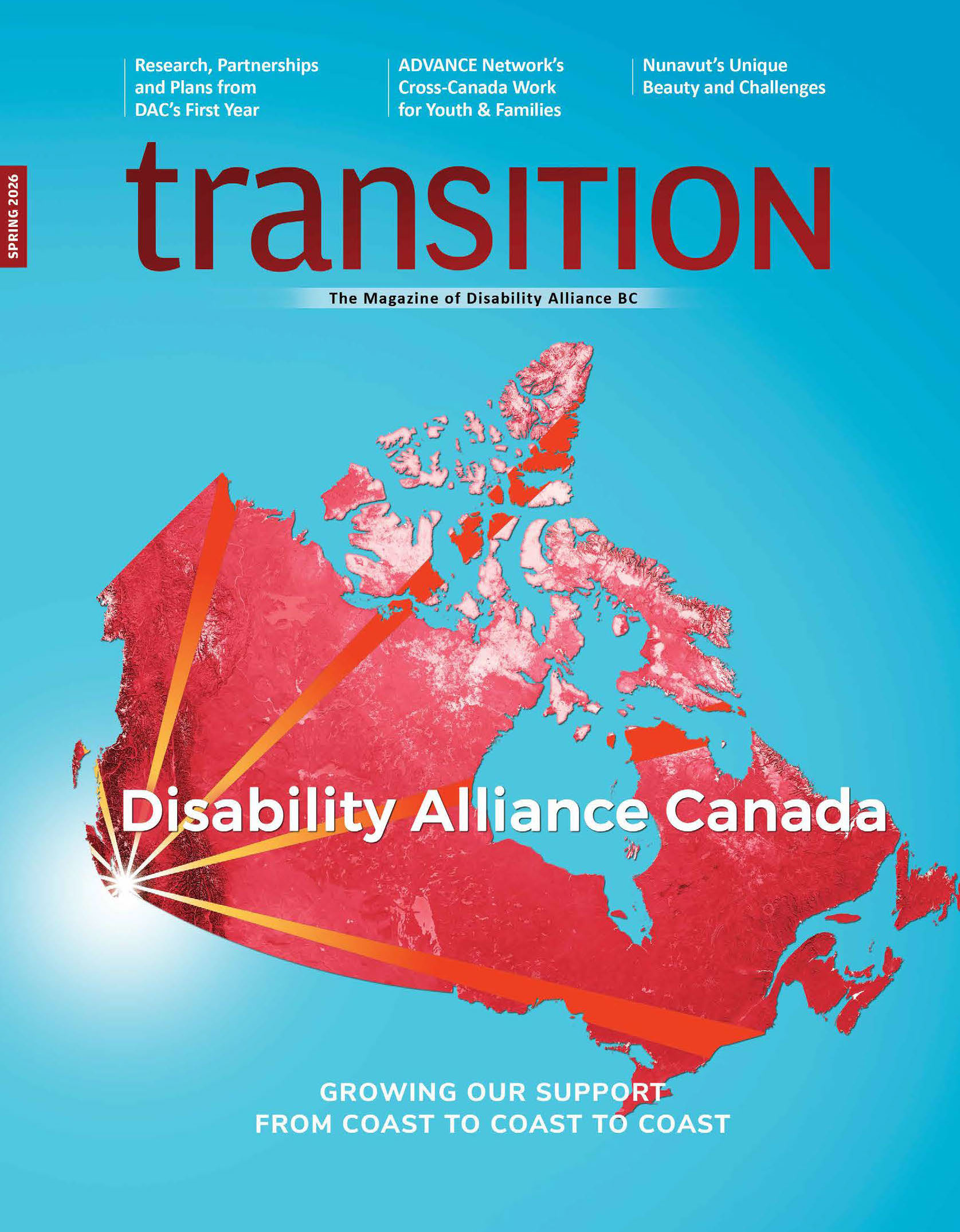
Transition Magazine: Editorial by Christine Gordon

Headshot of Christine Gordon. She has short silver hair and dark glasses. This editorial was written by Christine Gordon, and originally appeared in the edition of DABC’s Transition magazine, Following Their Path: How disability trailblazers are guiding today’s advocacy (Fall/Winter 2025).

Read the full edition in PDF format here and in text-only format here.

If you’re interested in contributing to Transition as an individual or an organization, please email transition@dabc.ca.


This issue of Transition honours some of the trailblazers in the disability rights movement in British Columbia.

The movement is not very old–only a couple of generations–and it has struggled to redefine disability as a social rather than an individual problem, and to wrest control of the definitions of disability away from the medical domain and lodge them squarely in the political and economic world where they rightly belong.

What makes a trailblazer? Generally, it is the force of circumstance which is encountered by individuals who are not content to live within the constraints imposed upon them. Trailblazers always have a clear vision of what the world could be. They are ingenious problem-solvers and fearless advocates. They lead by example and by taking action. In most cases, they are reluctantly thrust into the spotlight because there is a vacuum to be filled and they heed the call. Authentic trailblazers are usually not self-promoters.

In this edition of Transition, Roger Jones reflects on some of the people that he regards as trailblazers, while downplaying his own contributions as a lightning rod for galvanizing new approaches to assistive technology, accessible transportation, individualized funding and economic development. Roger has been an ambassador of the disability movement to power brokers and entrepreneurs and has mentored a whole generation of young people.

Robin Loxton describes the evolution of DABC’s Advocacy Access program and forgets to mention that he was the glue that held everything together for 27 years. His expertise in the byzantine world of disability benefits was unmatched and he applied it tirelessly not only for the individuals that he served, but also in pursuit of systemic changes that would lift people with disabilities out of poverty.

This edition is dedicated to Pam Horton. Pam was a quiet person with steely determination who never said no to an opportunity to speak truth to power. She volunteered for more committees than anyone could dream of and she took every one of them seriously.

Monica Gärtner shares some of her story of living with a genetic disability and evolving as an advocate, writer and performer.
Dave Symington was an artist at heart and he found a way to use music and performance to redefine public perceptions of disability.

Heather McCain’s article describes many home-grown trailblazers converted by the force of circumstance and applying their moral compass and sheer determination to make change.

What can we do to celebrate trailblazers?

First, we must be thankful for their individual contributions and appreciative of their sacrifices.

Then we must recognize that trailblazing means exactly what it says: creating a path forward. If we don’t use a path then we will lose it. A trailblazer’s most fervent wish is to change the world. They demonstrate the power of individual action to do just that. Trailblazers also teach us about the value of persistence which in itself is a synonym for hope. Lasting change must be constantly reinforced at its roots and never taken for granted.

This edition is dedicated to Pam Horton. Pam was a quiet person with steely determination who never said no to an opportunity to speak truth to power.

All of the trailblazers featured in this Transition encouraged and built collective approaches to changing the world. They help us to focus on the fact that individuals, no matter how gifted, are not enough. Sustainable change lies within developing coalitions, associations, organizations and inviting people to join in.

During these troubled and dystopic times, trailblazers might urge us to double down on moral clarity, strategic ingenuity, fearless collective action and the power of the voice of lived experience.

Christine Gordon has had a lifelong commitment to ground-up community development, and law and policy reform that shifts traditional power balances.

In her work with Disability Alliance BC and other organizations, she coordinated the decade long reform of the Adult Guardianship laws, helped to develop the Provincial Respiratory Outreach Program and engineered the creation of Technology for Living. she also coordinated the Equipment and Assistive Technology Initiative, developed the CARMA program and the Right Fit program, initiated the Individualized Funding project and mentored the BC Persons with Aids Society.

She has been actively engaged in health care reform including the Healthy Communities movement, the design of the Medicare Protection Act and the deinstitutionalization of the George Pearson Centre.

Webinar: How to Fund Your Accessibility Projects in 2026

Untapped Accessibility and Easy Surf are pleased to present a webinar that will help BC organizations take action on accessibility in 2026 by connecting attendees to funders with accessibility-focused funding streams.

Panelists include representatives from funders including SPARC BC, Disability Alliance BC, Trans Canada Trail, Rick Hansen Foundation, and Vancouver Foundation.

Join moderators Trish Kelly, Managing Director of Untapped Accessibility and Noah Senecal-Junkeer, co-founder of Easy Surf as they explore with the panel:

  • Why funding accessibility is important
  • How to access each funding stream
  • Stories of successful projects
  • Supports available to help your organization develop a project concept and execute the project

Accessibility information

Live captions and ASL interpreters will be provided. An accessible slide deck is available in advance by request. Did we miss anything? You can request additional accessibility features when you register or email info@untappedaccessibility.ca.