The SDSP: A lesser known RDSP option for Shortened Life Expectancy
The RDSP was designed as a long-term financial tool for people with the Disability Tax Credit, but life doesn’t always follow a long-term plan. The Registered Disability Savings Plan is often associated with long term savings, government grants and bonds, and planning for the future. However, for an RDSP beneficiary with a shortened life expectancy of five years or less, there is an important option that many families don’t know about: the Specified Disability Savings Plan (SDSP).
An SDSP is a special designation that can provide greater flexibility in accessing money already saved in an RDSP. It can be important when the purpose of financial planning shifts from long term savings to making resources available during the beneficiary’s lifetime.
To qualify for an SDSP, a licensed doctor or a nurse practitioner can certify in writing that a person with a disability is unlikely to survive more than five years. The RDSP holder then makes the SDSP selection with the financial institution that is administering the plan for them. The person with the RDSP can either keep the RDSP under the normal specified year rules, or they can elect to turn their RDSP into an SDSP.
Specified year RDSP vs. SDSP:
An RDSP does not automatically become an SDSP without the beneficiary’s permission. When a shortened life expectancy is certified by the doctor or nurse practitioner, the RDSP can remain in an RDSP during a specified year, or the holder can choose to have it turn into an SDSP. Understanding the difference between these options is an important part of making an informed decision.
A specified year RDSP can provide significant withdrawal flexibility, while the SDSP provides its own set of rules intended to allow greater access to the plan without the usual proportional repayment of the assistance holdback amount.
Under the regular RDSP rules, early withdrawals can trigger a proportional repayment of grants and bonds that were paid into the plan in the preceding 10 years. Generally, for every $1 withdrawn, $3 of grants and bonds can become subject to repayment up to the applicable assistance holdback amount.
The SDSP provides an important exception; an SDSP is important because early withdrawals don’t trigger the repayment assistance holdback amount (i.e. grants and bonds that are subject to the 10-year repayment rules) within the SDSP limits.
Generally, the SDSP permits up to $10,000 of taxable RDSP withdrawals per year without triggering the repayment of the assistance holdback amount. There are circumstances where the Lifetime Disability Assistance Payment (LDAP) formula requires a larger amount to be paid, in which case the $10,000 limit does not apply in the same way.
Things to Consider about the SDSP:
Once you elect to turn your RDSP into an SDSP, no further contributions can be made to this plan. This plan can also not receive new Canada Disability Saving Grants or Disability Savings Bonds. The beneficiary cannot accumulate new grant or bond carry forward amounts under the SDSP and payments from the plan must begin within the applicable time frame.
For example, a family may have an RDSP with significant government contributions and a history of making regular contributions. If the beneficiary develops a condition associated with a shorter life expectancy, the family may need to consider whether maintaining the RDSP’s ability to receive future contributions and incentives is more important than having the additional withdrawal flexibility provided by the SDSP.
Before making an SDSP election, it can be worthwhile to speak with the RDSP issuer and a financial planner, tax professional, or other qualified advisor who understands the RDSP rules.
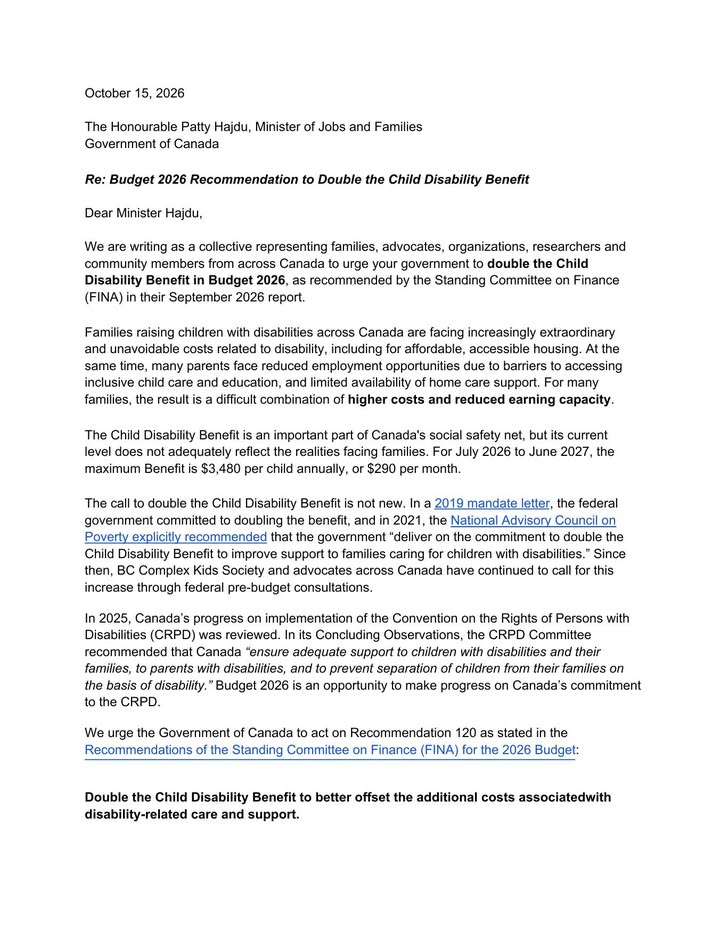
Letter to Minister Hajdu: Budget 2026 Recommendation to Double the Child Disability Benefit
DABC has signed on to following letter, sent to The Honourable Patty Hajdu, Minister of Jobs and Families. Read it below or download it here: Letter to Minister Hajdu.
October 15, 2026
The Honourable Patty Hajdu, Minister of Jobs and Families
Government of Canada
Re: Budget 2026 Recommendation to Double the Child Disability Benefit
Dear Minister Hajdu,
We are writing as a collective representing families, advocates, organizations, researchers and community members from across Canada to urge your government to double the Child Disability Benefit in Budget 2026, as recommended by the Standing Committee on Finance (FINA) in their September 2026 report.
Families raising children with disabilities across Canada are facing increasingly extraordinary and unavoidable costs related to disability, including for affordable, accessible housing. At the same time, many parents face reduced employment opportunities due to barriers to accessing inclusive child care and education, and limited availability of home care support. For many families, the result is a difficult combination of higher costs and reduced earning capacity.
The Child Disability Benefit is an important part of Canada’s social safety net, but its current level does not adequately reflect the realities facing families. For July 2026 to June 2027, the maximum Benefit is $3,480 per child annually, or $290 per month.
The call to double the Child Disability Benefit is not new. In a 2019 mandate letter, the federal government committed to doubling the benefit, and in 2021, the National Advisory Council on Poverty explicitly recommended that the government “deliver on the commitment to double the Child Disability Benefit to improve support to families caring for children with disabilities.” Since then, BC Complex Kids Society and advocates across Canada have continued to call for this increase through federal pre-budget consultations.
In 2025, Canada’s progress on implementation of the Convention on the Rights of Persons with Disabilities (CRPD) was reviewed. In its Concluding Observations, the CRPD Committee recommended that Canada “ensure adequate support to children with disabilities and their families, to parents with disabilities, and to prevent separation of children from their families on the basis of disability.” Budget 2026 is an opportunity to make progress on Canada’s commitment to the CRPD.
We urge the Government of Canada to act on Recommendation 120 as stated in the Recommendations of the Standing Committee on Finance (FINA) for the 2026 Budget:
Double the Child Disability Benefit to better offset the additional costs associated with disability-related care and support.
In addition we recommend raising the threshold at which the Benefit starts to be reduced and work with provinces and territories to prevent clawbacks.
We would welcome the opportunity to meet with you to share the experiences of families from across Canada and discuss how this investment can make a meaningful difference. Thank you for your consideration and for your commitment to building a Canada where every child and family can thrive.
Sincerely,
Brenda Lenahan
Executive Director, BC Complex Kids Society
Helaine Boyd
Executive Director, Disability Alliance BC
Dr Keiko Shikako
Canada Research Chair in Childhood Disability
Neil Belanger
Chief Executive Officer, Indigenous Disability Canada
Raihanna Hirji-Khalfan
National Director, Race and Disability Canada
Rabia Khedr
Chief Executive Officer, Disability Without Poverty
Krista Carr
Chief Executive Director, Inclusion Canada
Leila Sarangi
National Director, Campaign 2000: End Child and Family Poverty
Jennifer Zwicker
Canada Research Chair in Disability Policy for Children and Youth and Chief Scientist for Kids Brain Health Network
Rachel Martens
University of Calgary Research Knowledge Broker, Parent Advocate
Emily Gruenwoldt
President and CEO, Children’s Healthcare Canada and Executive Director, Pediatric Chairs of Canada
Cc
Prime Minister Mark Carney
François-Philippe Champagne, Minister of FInance and National Revenue
Leslie Church, Parliamentary Secretary to the Minister of Jobs and Families
Anna Gainey, Secretary of State – Children and Youth
Wayne Long, Secretary of State – Canada Revenue Agency and Financial Institutions
Karina Gould, Chair of the House of Commons Standing Committee on Finance