Do you prefer audiobooks and podcasts to print media? Are you already a fan of DABC’s Transition magazine, or have you been meaning to check it out? You’re in luck!
We’re excited to announce that the Fall/Winter 2025 edition of Transition is now available as a podcast on Spotify and Substack. 🎧
The theme of the edition is Following Their Path: How disability trailblazers are guiding today’s advocacy, and it is dedicated to the late Pamela Horton.
Check it out on your favourite platform (search: Transition Magazine Podcast or use the links above) and be sure to follow us so you don’t miss future episodes.
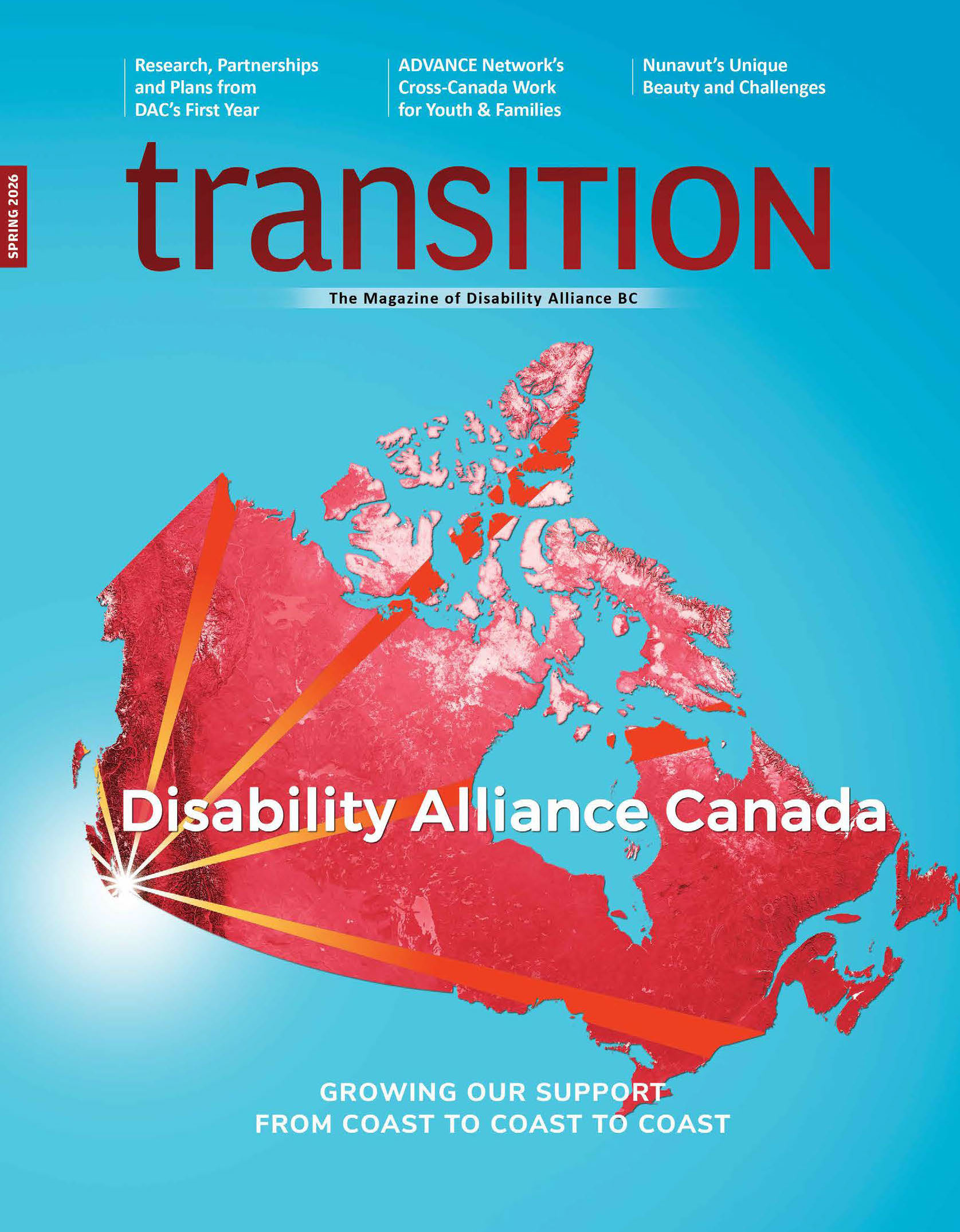
The theme of the Spring 2026 edition of Transition magazine is Disability Alliance Canada: Growing Our Support from Coast to Coast. As we reflect on Disability Alliance Canada’s (DAC) first year, we hear from organizations doing great work across the country and share what we’ve learned about unmet needs that will shape DAC’s systemic advocacy.
We’re always happy to consider articles or creative work from our community partners and from people living with a disability. If you’d like to send along your ideas or feedback, email: transition@dabc.ca.
This article was written by Margaret Fraser, and originally appeared in the edition of DABC’s Transition magazine, Following Their Path: How disability trailblazers are guiding today’s advocacy (Fall/Winter 2025).
Read the full edition in PDF format here and in text-only format here.
If you’re interested in contributing to Transition as an individual or an organization, please email transition@dabc.ca.
This edition of Transition Magazine is dedicated to the late Pamela Horton. Pam served on DABC’s board of directors for close to thirty years. If you’d like to support Transition, we have set up a fund in Pam’s name. We so appreciate any contributions.
Pam Horton grew up in North Vancouver in the 1950’s and 60’s with her brother, Mom and Dad. She had an active life, loving the outdoors, mastering a range of crafts and later finding work in the administrative field.
On February 9, 1982, at age 28, she was diagnosed with multiple sclerosis. She often spoke of this as her second birthday.
When the shock began to wear off, her goals changed. Pam wanted to focus on working on behalf of the disability community—first on the North Shore, then Greater Vancouver and ultimately province-wide.
Pam worked extremely hard to maintain her physical health as much as possible, through physiotherapy and mentally through volunteering. She was an excellent collaborator and communicator. She sat on numerous committees and challenged politicians, civil servants and anyone who would listen. She also made many friends.
Co-chairing the Together Against Violence Network on the North Shore was a perfect example of her understanding of intersectional issues for people with disabilities. Pam always prioritized inclusion. Each November, she enlisted her mother, Ruth, to cut purple ribbons—thousands over the years—to raise awareness of the issues close to her heart.
And Pam was not just a “joiner.” Encouraging and creating advisory committees on disability became one of her most far-reaching contributions to change, not only in the general public’s attitudes, but in those involved in government decisions at every level.
She was instrumental in so many changes in transportation that we now take for granted, such as accessible buses and taxis, including education for drivers on how to respectfully and safely assist those with disabilities.
When it came to income security, Pam worked to improve the living situations for the many people who rely on government assistance and programs, addressing problems from rental costs to equipment expenses.
In 1998, the North Shore Disability Resource Centre opened and it continues its work today. Pam and her various teams raised money for a host of initiatives at the centre including public education.
She worked with youth, adults and seniors and was never afraid to speak up on behalf of others.
In the arts, it was her persistence and invincible approach that led to the wheelchair accessible renovation of Centennial Theatre in North Vancouver.
On the quirky side, Pam was known for her love of owls! You may know an owl represents a wise creature–there’s a connection there–and she amassed a collection of owl-related photographs, trinkets, earrings and kitchen gadgets. You name it.
Her ultimate passion was the successful development of Disability Alliance BC. Pam was the first Executive Director and later sat on the Board of Directors for many years. She used her strong voice to advocate across the province for people with all types of disabilities.
Pam took a courageous stand beside Sue Rodriguez. She supported Rodriguez’s trailblazing right-to-die advocacy in the 90s that eventually lead to the creation of Medical Assistance in Dying (MAID) in BC.
And she did so while also articulating the serious concerns about the potential for MAID to be misused around people with disabilities.
What follows are some thoughts from Pam’s friends and colleagues. The world is a much better place because of Pam. After her passing in May of this year, she will be missed by many and forgotten by none.
“Fearless and respected.”
“Gracious with her time and gave generously.”
“Able to retain her dry wit and knowing smile in the most difficult times.”
“Always kind and generous.”
“A good, truthful friend no matter what.”
“A stellar human being who made a tremendous contribution to our communities and, in many respects, changed so many people’s lives for the good.”
“An unflinching advocate for accessibility and the rights of people with disabilities.”
—–
Over the course of her 40-year working life, Margaret Fraser worked in a variety of roles with, and advocated for, people with a broad range of disabilities, frail and isolated seniors, youth at risk, new immigrants and adult literacy groups. She held hands-on roles as well as positions in management, and learned much about how folks progress through life–more than a university education can provide. Originally from Scotland, she immigrated to Canada in 1983. She remains an active volunteer in North Vancouver.